
Remote Patient Monitoring Market to reach USD 438.77 Billion by 2035 at 18.5% CAGR
Remote Patient Monitoring Market to Surge from USD 79.48 Billion in 2025 to USD 438.77 Billion by 2035—By Chronic

Press Release Disclaimer: This is a press release distributed through the XPR Media network. It has not been independently verified by our newsroom.
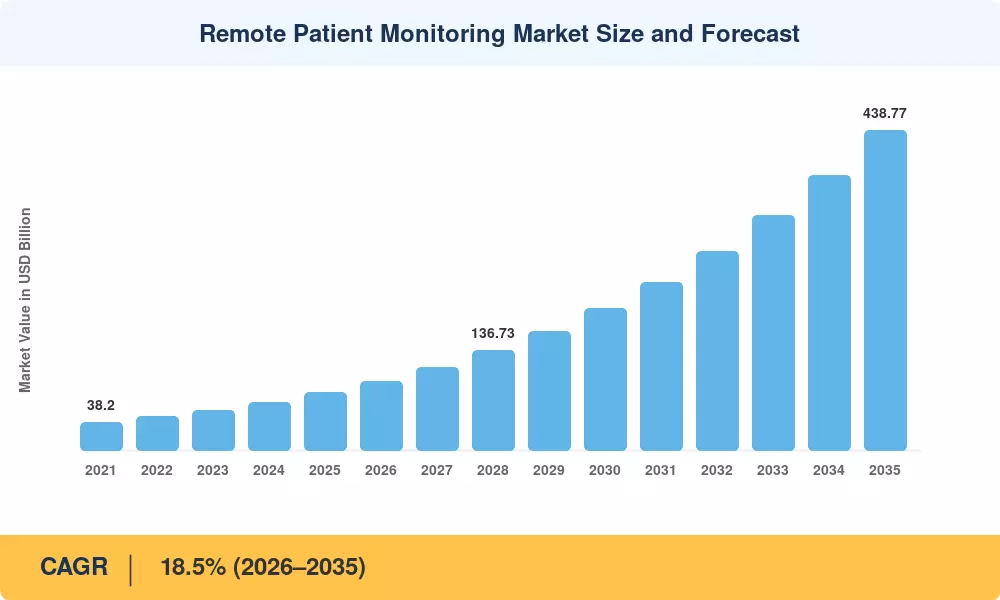

Remote Patient Monitoring Market to Surge from USD 79.48 Billion in 2025 to USD 438.77 Billion by 2035—By Chronic Disease Burden, Wearable Technology Adoption
NY, CA, UNITED STATES, August 31, 2026 /EINPresswire.com/ — As per Market Research Future, the global Remote Patient Monitoring Market size is projected to reach USD 438.77 Billion by 2035 from USD 79.48 Billion in 2025, at a CAGR of 18.5% during the forecast period 2026–2035.
The extraordinary 18.5% CAGR is propelled by three converging forces: the rising prevalence of chronic conditions such as diabetes, cardiovascular diseases, and cancer, which affect over 50% of the U.S. population alone and necessitate continuous monitoring outside traditional settings; the widespread adoption of wearable devices and mobile health applications, which empower patients to actively participate in their own care and provide clinicians with continuous, real-time health data; and a global policy shift toward value-based care models, creating strong economic incentives for providers to adopt RPM as it demonstrably reduces hospital readmissions and improves patient outcomes.
Major technology and healthcare companies are responding to this demand. The market is characterized by significant strategic collaborations between healthcare providers and technology firms to expand product offerings and improve accessibility. Substantial capital investments, estimated at over USD 2.5 billion, are being funneled into the development of AI-driven analytics, biosensors, and advanced software platforms.
Request A Free Sample:
https://www.marketresearchfuture.com/sample_request/10905
Key Market Trends & Growth Drivers
The Rise of Wearable Devices and AI-Driven Insights
The Devices segment dominates the market, driven by the growing adoption of wearable and portable devices like glucose monitors, pulse oximeters, and ECG trackers. Wearable technology allows for continuous, real-time health data collection, enabling proactive care. The Services segment, however, is the fastest-growing, fueled by rising demand for telemonitoring and data management services that ensure continuous patient engagement. The integration of AI and ML is a transformative force, analyzing vast patient data to enable more accurate diagnoses, personalized treatment plans, and predictive health issue identification.
Shifting to Value-Based and Home Care
A key driver is the global healthcare shift from volume-based to value-based care. RPM is central to this transition, as it demonstrably reduces hospital readmissions and lowers the total cost of care. This is complemented by a growing emphasis on home healthcare. Patients increasingly demand convenient, interactive services, and RPM solutions offer a way to receive high-quality care in the comfort of their own homes. The Patients segment is therefore projected to grow at the fastest rate, reflecting increasing patient awareness and acceptance of self-monitoring tools.
Ask for Customization:
https://www.marketresearchfuture.com/ask_for_customize/10905
Market Segment Insights
BY TYPE
Devices: Dominant segment, driven by growing adoption of wearable and portable devices such as glucose monitors, pulse oximeters, and ECG trackers.
Services: Fastest-growing segment, owing to rising demand for telemonitoring and data management services that enable continuous patient engagement.
BY APPLICATION
Cardiovascular Diseases: Largest segment, accounting for the largest share due to high prevalence of heart-related conditions and integration of remote cardiac monitoring technologies.
Diabetes: Fastest-growing segment, supported by rising global diabetes incidence and advancements in glucose monitoring technologies.
BY END-USER
Providers: Held the largest market share, driven by widespread adoption of RPM technologies by healthcare organizations to enhance patient care and reduce hospital readmissions.
Patients: Projected to grow at the fastest rate, reflecting increasing awareness and acceptance of self-monitoring tools and personalized healthcare solutions.
Read Detailed Insights:
https://www.marketresearchfuture.com/reports/remote-patient-monitoring-market-10905
Regional Outlook
North America — Market Leader
North America held the maximum market share in 2025 and is projected to maintain its dominance throughout the forecast period. This leadership is supported by an advanced healthcare infrastructure, high adoption of digital health technologies, and favorable government reimbursement policies, such as expanded Medicare coverage for RPM services. The U.S. leads the market with major contributions from key players.
Europe — Significant Growth
Europe represents another significant market, with supportive government initiatives and a strong emphasis on digital health and telehealth services.
Asia-Pacific — Fastest-Growing Region
The Asia-Pacific region is anticipated to experience the strongest growth, driven by increasing healthcare investments, a large patient population, rising awareness of RPM benefits, and expanding access to digital technologies.
Competitive Landscape
The Remote Patient Monitoring Market is highly competitive, with a mix of established healthcare giants and innovative technology companies focused on innovation, strategic partnerships, and expanding their product portfolios.
KEY COMPANIES:
Philips
Medtronic
GE Healthcare
Honeywell
Abbott
Boston Scientific
Siemens Healthineers
BioTelemetry
Masimo
Future Outlook: 2026–2035
The Remote Patient Monitoring Market is on a trajectory to reach USD 438.77 Billion by 2035, driven by continuous technological innovation, increasing consumer demand, and the ongoing shift toward value-based care. The integration of AI, advanced biosensors, and 5G connectivity will further enhance the capabilities and accessibility of RPM solutions.
Key opportunities lie in:
Expanding into emerging markets with mobile-first health solutions.
Developing specialized software for new therapeutic areas such as oncology and mental health.
Integrating AI for predictive analytics to enable proactive intervention and personalized care.
Forging new partnerships between technology firms and healthcare providers to create integrated care ecosystems.
By 2035, RPM is expected to be a foundational element of modern healthcare delivery, transforming the patient experience and making care more proactive, personalized, and efficient.
More Related Research Insights:
https://www.marketresearchfuture.com/reports/guillain-barre-syndrome-market-5741
https://www.marketresearchfuture.com/reports/genitourinary-drugs-market-6802
https://www.marketresearchfuture.com/reports/live-cell-encapsulation-market-7772
https://www.marketresearchfuture.com/reports/medical-kiosk-market-26505
https://www.marketresearchfuture.com/reports/filter-integrity-test-market-21571
https://www.marketresearchfuture.com/reports/hyperbaric-oxygen-therapy-market-30668
https://www.marketresearchfuture.com/reports/schizophrenia-market-1625
https://www.marketresearchfuture.com/reports/medical-nutrition-market-1330
https://www.marketresearchfuture.com/reports/plasma-fractionation-market-7397
https://www.marketresearchfuture.com/reports/companion-diagnostic-market-3077
Market Research Future
Market Research Future
+1 855-661-4441
email us here
Legal Disclaimer:
EIN Presswire provides this news content “as is” without warranty of any kind. We do not accept any responsibility or liability
for the accuracy, content, images, videos, licenses, completeness, legality, or reliability of the information contained in this
article. If you have any complaints or copyright issues related to this article, kindly contact the author above.

Media gallery


