
Chip Antenna Market Revenue Expected to Reach USD 11.27 Billion by 2035 at 17.4% CAGR
Chip Antenna Market Size, Share and Research Report By Type (LTCC (Low-Temperature Co-Fired Ceramic) Chip Antenna,

Press Release Disclaimer: This is a press release distributed through the XPR Media network. It has not been independently verified by our newsroom.
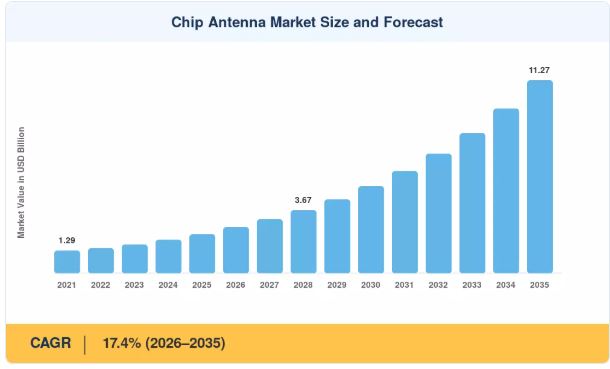

Chip Antenna Market Size, Share and Research Report By Type (LTCC (Low-Temperature Co-Fired Ceramic) Chip Antenna, Dielectric Chip Antenna, and Printed PCB)
NEW YORK,, NY, UNITED STATES, August 31, 2026 /EINPresswire.com/ — The Global Chip Antenna market was valued at USD 2.25 billion in 2025 and is projected to open the forecast window at USD 2.66 billion in 2026 before reaching USD 11.27 billion by 2035, expanding at a 17.4% CAGR between 2026 and 2035. Two catalysts anchor that trajectory. India’s Electronic Components Manufacturing Scheme, cleared in March 2025 with an outlay of roughly USD 2.7 billion, pulls passive and RF component assembly onto domestic lines. In parallel, the European Union’s Radio Equipment Directive cybersecurity delegated act, enforceable from 1 August 2025, forces a redesign cycle across connected consumer hardware and drags antenna selection back into the schematic review. The market’s expansion reflects the convergence of 5G and 5G-Advanced network densification (+3.8% impact), IoT and tracker unit shipment growth (+3.4%), consumer electronics miniaturisation (+2.9%), and automotive connectivity and in-cabin radar (+2.6%) accelerating across the world’s largest electronics-assembly and connected-device economies simultaneously.
Asia-Pacific dominates with nearly 42.4% of 2025 revenue, supported by extensive Chinese, Korean, and Taiwanese electronics manufacturing and module assembly. North America is projected to grow fastest at an 18.2% CAGR, driven by Wi-Fi 6E deployment and automotive telematics, while Europe accounts for approximately 21.5% through industrial and medical device demand.
The Chip Antenna Market is gaining significant momentum as connected devices become smaller, smarter, and more wireless. The Chip Antenna Market is benefiting from expanding IoT deployments, connected automobiles, smartphones, wearables, wireless networking, and compact electronic devices that require efficient antenna solutions within limited spaces.
Get Full PDF Sample Copy of Report: (Including Full TOC, List of Tables & Figures, Chart) @
https://www.marketresearchfuture.com/sample_request/1582
➤ Growing Adoption of Compact Antennas:
Modern electronic products are becoming increasingly compact while supporting more wireless functions. Chip antennas provide manufacturers with a miniature solution that can be integrated directly onto printed circuit boards, making them suitable for space-constrained applications. Their compact footprint can simplify product design while supporting wireless connectivity across multiple frequency bands. As manufacturers seek to reduce device size without sacrificing communication capabilities, chip antenna technology is becoming increasingly important in next-generation electronics.
➤ Internet of Things Drives Demand:
The rapid expansion of the Internet of Things is one of the strongest growth catalysts for chip antennas. Connected sensors, smart appliances, industrial devices, trackers, and monitoring systems require reliable wireless communication while often operating under severe space and power constraints. Chip antennas can support technologies such as Bluetooth, Wi-Fi, Zigbee, and other short-range wireless protocols. As billions of connected devices continue entering commercial and consumer environments, demand for compact antenna components is expected to increase.
➤ Consumer Electronics Expansion:
Smartphones, tablets, wireless earbuds, smartwatches, gaming devices, and other consumer electronics are important application areas for chip antennas. Consumers increasingly expect products to provide multiple wireless connectivity options within increasingly smaller form factors. Manufacturers are therefore integrating miniature antennas that can support Bluetooth, Wi-Fi, GNSS, and other communication functions. Improvements in antenna materials and design are allowing engineers to achieve better performance while maintaining highly compact footprints.
➤ Automotive Connectivity Creates Opportunities:
The automotive industry is becoming a major growth area for chip antenna technology. Modern vehicles incorporate numerous wireless functions, including navigation, Bluetooth communication, Wi-Fi connectivity, remote diagnostics, keyless entry, vehicle tracking, and telematics. Connected and software-defined vehicles require reliable communication between onboard systems and external networks. Compact antennas can help automotive manufacturers integrate multiple communication capabilities while optimizing available space inside increasingly electronics-intensive vehicles.
➤ Automotive Telematics and Safety:
The expansion of automotive telematics is increasing the need for dependable RF components. Telematics systems enable vehicles to communicate data related to location, performance, diagnostics, emergency services, and fleet management. Chip antennas can be integrated into automotive modules used for these applications, helping manufacturers create smaller and more flexible communication systems. Growing connected-car adoption and technology requirements are therefore expected to support long-term antenna demand.
Get access to the full description of the report @
https://www.marketresearchfuture.com/reports/chip-antenna-market-1582
➤ Who Are the Key Players in the Chip Antenna Market?
Concentration in the chip antenna market is moderate rather than tight. Estimated HHI sits near 1,180, with the top five suppliers holding roughly 52-58% of global revenue, leaving a long tail of specialists and regional producers. Japanese and Taiwanese incumbents dominate ceramic manufacturing, while a cluster of design-led firms competes on tuning support and reference-design depth rather than fabrication scale. MRFR identifies the following key participants with estimated revenue share ranges:
• Murata Manufacturing
• TDK Corporation
• Yageo / Pulse Electronics
• Taiyo Yuden
• Johanson Technology
• Antenova
• Ignion (~3–5% share)
• Abracon
• Molex
• Sunlord Electronics
Strategic competition in the chip antenna market is increasingly defined by coexistence engineering and phase-stability documentation rather than footprint alone, with multi-radio coexistence and desense in compact enclosures cited as the top structural headwind, contributing an estimated -2.4% drag on CAGR as adjacent-channel desense of 8-14 dB is seen from field measurements when BLE and Wi-Fi elements are co-located within 12 mm without filtering, alongside average selling price erosion of roughly 22% in commodity 2.4 GHz BLE parts since 2022, patent disputes over fractal and meander geometries, ceramic feedstock and rare-earth input volatility, and antenna-in-package displacement at the SoC level for millimetre-wave applications.
➤ What Are the Emerging Trends in the Chip Antenna Market?
Several transformational trends are redefining the chip antenna market’s evolution through 2035:
Bluetooth Channel Sounding and the Precision Refresh: Bluetooth SIG’s 6.0 release in September 2024 introduced Channel Sounding, delivering centimetre-class distance measurement that legacy RSSI methods never approached, an accuracy level sensitive to phase stability that favours ceramic dielectrics over flexible printed elements, with digital key, tag, and access-control programmes already re-specifying around it.
Automotive Qualification as a Margin Moat: AEC-Q200 qualification for parts rated to -40°C to +125°C operation commands 2.5 to 4 times the cost of consumer-grade equivalents, with design cycles of five to seven years, positioning suppliers who invest in certification lines today to ride the V2X and radar attach wave.
Medical Telemetry and Body-Worn Devices: The FDA’s expanded remote patient monitoring reimbursement pathways have pushed continuous glucose monitors, cardiac patches, and hearing devices into volume production, builds that need parts holding efficiency against high-permittivity human tissue, a genuinely difficult specification that rewards materials expertise over price.
Emerging-Market Metering and Utility Infrastructure: India’s Revamped Distribution Sector Scheme targets 250 million smart meters with a sanctioned outlay above USD 36 billion, with comparable programmes running across Brazil, Indonesia, and Saudi Arabia, and localisation rules in several of these markets creating openings for regional assembly partnerships rather than pure export.
Private 5G and Industrial Sensing: Germany alone has licensed more than 4,500 local 5G campus networks, each populating shop floors with connected sensors and handheld terminals, and industrial enclosures being metallic and electrically hostile pushes designers toward parts with published performance under ground-plane loading.
Buy Full Research Report:
https://www.marketresearchfuture.com/checkout?currency=one_user-USD&report_id=1582
➤ How Is the Chip Antenna Market Segmented?
The chip antenna market report provides a comprehensive segmentation framework:
By Type: LTCC (Low-Temperature Co-Fired Ceramic) Chip Antenna (53.3% share, 2025), Dielectric Chip Antenna (18.5% CAGR), Printed PCB-Embedded Chip Antenna (USD 0.42 billion, 2025)
By Application: WLAN/Wi-Fi (USD 0.55 billion, 2025), Bluetooth/BLE (38.4% share, 2025), Dual-Band/Multi-Band (18.9% CAGR), GPS/GNSS (19.5% CAGR), LPWAN — NB-IoT, LoRa, Sigfox (USD 0.19 billion, 2025)
By End-User Industry: Automotive (18.4% CAGR), Consumer Electronics (USD 0.77 billion, 2025), Healthcare and Medical Devices (19.1% CAGR), IT and Telecommunications Infrastructure (30.2% share, 2025), Others — Industrial, Aerospace, Retail (8.3% share, 2025)
By Region: North America (18.2% CAGR), Europe (21.5% share, 2025), Asia-Pacific (42.4% share, 2025), South America (USD 0.11 billion, 2025), Middle East & Africa (18.9% CAGR)
➤ Regional Market Insights:
Asia-Pacific leads the global industry with approximately 42.4% of 2025 revenue. The region benefits from a strong electronics manufacturing ecosystem, extensive semiconductor and module production, and large-scale consumer device manufacturing. China, South Korea, and Taiwan remain important hubs for electronic component production and assembly. Continued growth in smartphones, IoT equipment, automotive electronics, and industrial devices is expected to reinforce Asia-Pacific’s leadership.
➤ North America Market Outlook:
North America is forecast to record the industry’s fastest regional expansion at an estimated 18.2% CAGR. Wireless networking upgrades and expanding automotive connectivity are major contributors to regional demand. The increasing deployment of advanced Wi-Fi technologies and the growth of connected-vehicle platforms are encouraging manufacturers to adopt sophisticated RF components. Strong investment in IoT, telecommunications, smart devices, and technology infrastructure further supports market growth.
➤ European Market Development:
Europe accounts for approximately 21.5% of the market and has strong potential across industrial and medical applications. European manufacturers are increasingly implementing wireless connectivity in factory automation, healthcare technologies, and intelligent equipment. The region’s focus on industrial digitization and connected medical devices supports demand for premium antenna components. Reliability, efficiency, miniaturization, and performance are particularly important considerations for specialized European applications.
➤ Competitive Landscape:
Competition in the chip antenna industry focuses on miniaturization, signal performance, frequency coverage, reliability, customization, and manufacturing efficiency. Suppliers are developing new materials and architectures to satisfy increasingly demanding requirements across consumer, automotive, industrial, and medical applications. Partnerships with electronics manufacturers and module developers are also important. Companies that provide application-specific designs and strong engineering support can strengthen their position as wireless technologies become more complex.
➤ Key Market Challenges:
Despite strong growth potential, chip antenna manufacturers face challenges related to signal interference, limited installation space, device orientation, and surrounding materials. Antenna performance can vary significantly depending on PCB layout and the final product enclosure.
Design engineers must therefore optimize antenna placement carefully and conduct extensive testing. Pricing pressure and rapid product development cycles can also require manufacturers to continually improve performance while maintaining competitive costs.
➤➤➤ Regional & Country-Level Reports by Market Research Future:
US Chip Antenna Market –
https://www.marketresearchfuture.com/reports/us-chip-antenna-market-14073
➤➤➤ Industry Analysis Reports by Market Research Future:
Equipment Monitoring Market
https://www.marketresearchfuture.com/reports/equipment-monitoring-market-7477
Fiber Management Systems Market
https://www.marketresearchfuture.com/reports/fiber-management-systems-market-11929
Push Rod Sensor Market
https://www.marketresearchfuture.com/reports/push-rod-sensor-market-12407
Smartwatch Battery Market
https://www.marketresearchfuture.com/reports/smartwatch-battery-market-12503
Energy Storage System Battery Management System Market
https://www.marketresearchfuture.com/reports/energy-storage-system-ess-battery-management-system-bms-market-12571
Fully Automatic Molding Machine Market
https://www.marketresearchfuture.com/reports/fully-automatic-molding-machine-market-13904
Japan High Precision Gnss Module Market
https://www.marketresearchfuture.com/reports/japan-high-precision-gnss-module-market-16083
Industrial Thermopile Sensors Market
https://www.marketresearchfuture.com/reports/industrial-thermopile-sensors-market-17187
Handheld Marine Radio Market
https://www.marketresearchfuture.com/reports/handheld-marine-radio-market-16106
Hyper Automation Market
https://www.marketresearchfuture.com/reports/hyper-automation-market-19259
Market Research Future
Market Research Future
+ +1 855-661-4441
email us here
Legal Disclaimer:
EIN Presswire provides this news content “as is” without warranty of any kind. We do not accept any responsibility or liability
for the accuracy, content, images, videos, licenses, completeness, legality, or reliability of the information contained in this
article. If you have any complaints or copyright issues related to this article, kindly contact the author above.

Media gallery


