
Rising Football Participation and Digital Retail to Drive Football Market at 3.02% CAGR Through 2035
Football Market is projected to reach USD 12.18 billion by 2035, driven by digital retail, product innovation, football

Press Release Disclaimer: This is a press release distributed through the XPR Media network. It has not been independently verified by our newsroom.
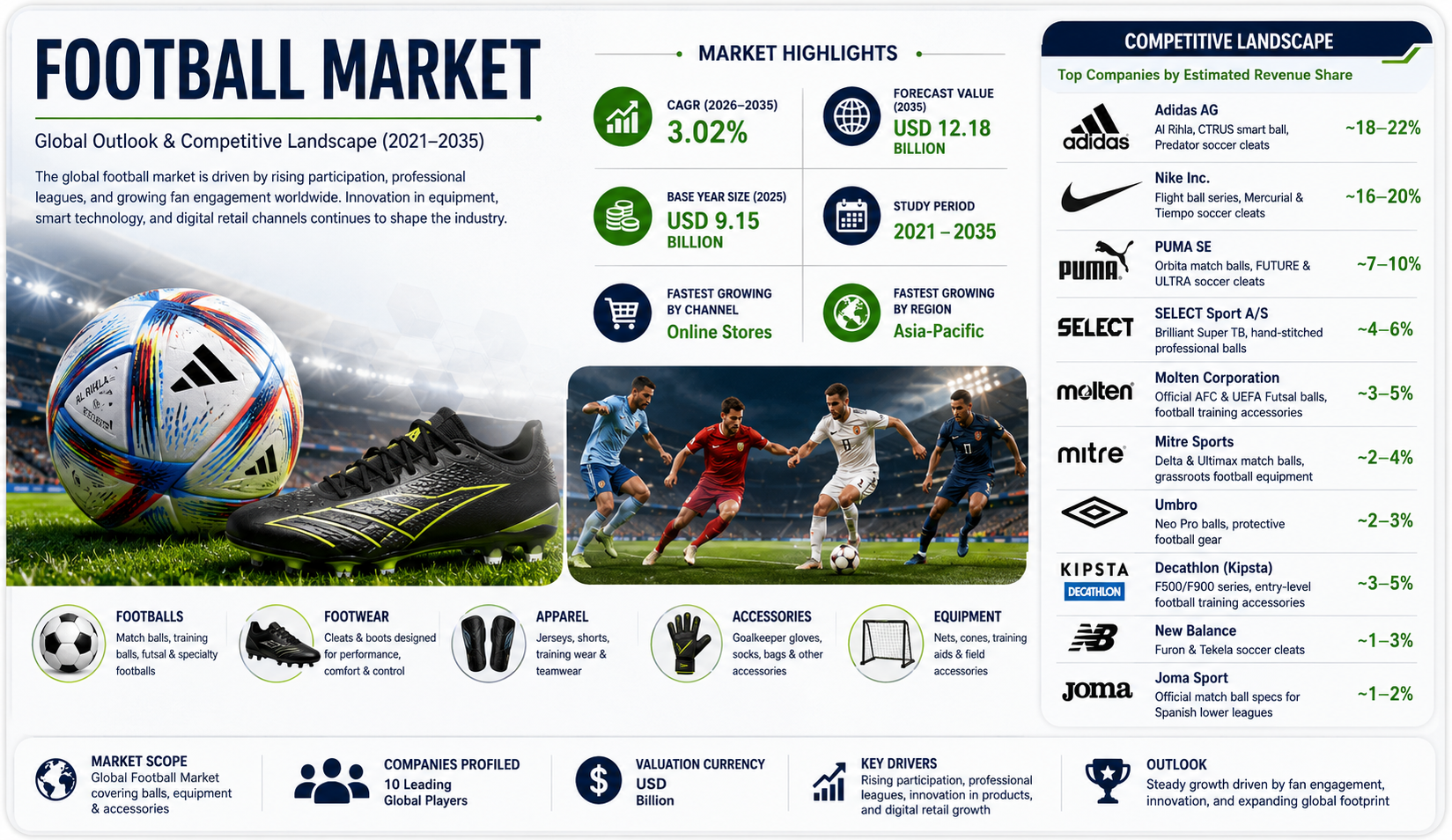

Football Market is projected to reach USD 12.18 billion by 2035, driven by digital retail, product innovation, football participation, and Asia-Pacific growth.
NEW YORK, NY, UNITED STATES, August 25, 2026 /EINPresswire.com/ —
The global Football Market is entering a period of steady expansion as football participation, professional competitions, grassroots programs, training activities, and consumer spending on performance equipment continue to broaden. The market covers footballs, soccer cleats and boots, training equipment, protective gear, and related accessories sold through offline and online channels. Valued at approximately USD 9.15 billion in 2025, the market is projected to reach USD 12.18 billion by 2035, advancing at a 3.02% CAGR from 2026 to 2035. Growth is being supported by the increasing professionalization of amateur football, rising youth participation, product innovation, and the expanding influence of major international tournaments.
The competitive landscape is concentrated around global sportswear companies and specialized football-equipment manufacturers. Adidas AG holds an estimated 18–22% revenue share range, supported by premium match balls, FIFA licensing, Predator footwear, and connected-ball technology, while Nike Inc. commands an estimated 16–20% through Flight footballs, Mercurial and Tiempo boots, athlete endorsements, and its direct-to-consumer digital ecosystem. PUMA SE, with an estimated 7–10%, competes through Orbita match balls and FUTURE and ULTRA footwear. Specialized brands including SELECT Sport A/S, Molten Corporation, Mitre Sports, Umbro, Decathlon’s Kipsta, New Balance, and Joma Sport strengthen the competitive environment through professional match balls, futsal products, grassroots equipment, value-oriented offerings, and regional partnerships.
Market Segmentation by Product
The football equipment segment encompasses match balls, training balls, footwear, protective equipment, goalkeeping accessories, training aids, and other related products. Match balls remain a core category because professional leagues, academies, schools, clubs, and recreational players require products differentiated by construction, durability, playing surface, and performance characteristics.
Premium footballs increasingly incorporate advanced panel configurations, textured surfaces, improved aerodynamic characteristics, and embedded sensing technologies. Adidas has extended this trend through its Connected Ball Technology, while brands such as SELECT and Molten maintain strong positions in professional and federation-level match balls. Training equipment represents another important opportunity as academies and grassroots organizations increasingly seek cones, agility equipment, rebounders, goalkeeper accessories, and specialized training systems.
Football footwear is also a major value-generating category. Players increasingly select boots according to speed, control, traction, lightweight construction, and playing position. Nike’s Mercurial and Tiempo ranges, Adidas Predator products, PUMA FUTURE and ULTRA lines, New Balance Furon and Tekela products, and Joma footwear demonstrate how brands target distinct performance requirements.
Market Segmentation by Distribution Channel
The online stores segment is expected to be the fastest-growing channel during the forecast period. E-commerce has changed the way football equipment is researched, compared, purchased, and replenished. Consumers can evaluate technical specifications, sizes, product reviews, price points, and product availability without visiting physical stores. This is particularly important for footwear, where multiple product variations and frequent launches create strong demand for digital merchandising.
Direct-to-consumer platforms also enable manufacturers to control product presentation, collect customer insights, introduce limited editions, and build loyalty programs. Nike and Adidas have invested heavily in digital ecosystems, while large sporting-goods retailers and marketplaces extend product availability to smaller cities and emerging football markets.
Offline retail nevertheless remains relevant, particularly for consumers who want to physically test footwear, evaluate ball construction, or receive fitting assistance. Sporting-goods stores, specialty football shops, club outlets, schools, and academies continue to provide important touchpoints.
Free Sample Copy Access A Complimentary Copy of Our Report to Explore Its Content and Insights
https://www.marketresearchfuture.com/sample_request/11988
Market Segmentation by Region
Asia-Pacific is positioned as the fastest-growing regional market, supported by expanding football participation, increasing investment in sporting infrastructure, rising disposable income, and the development of domestic leagues and grassroots programs. Countries across Southeast and South Asia are creating additional demand for affordable football equipment, training accessories, and youth-oriented products.
Europe remains an important established market because of its deep football culture, extensive professional club network, mature sporting-goods distribution infrastructure, and strong consumer preference for premium equipment. The region also provides manufacturers with opportunities to collaborate with football federations, leagues, and professional clubs.
North America represents a significant growth opportunity as football participation continues to gain visibility among youth and adult consumers. The expansion of professional competitions, investment in facilities, and increasing exposure surrounding major tournaments can support demand for football equipment and apparel.
Latin America maintains a structurally strong football culture, generating consistent demand for match balls, footwear, training equipment, and affordable products. Meanwhile, the Middle East and Africa offer longer-term opportunities through infrastructure development, youth academies, football initiatives, and increasing participation.
Key Growth Drivers
One of the strongest drivers is increasing global football participation. Football’s relatively accessible entry requirements make it suitable for schools, clubs, community programs, and recreational settings. Expansion of organized youth leagues and academy systems increases recurring demand for balls, footwear, protective equipment, and training accessories.
Product innovation is another important factor. Manufacturers are increasingly using lightweight materials, engineered surfaces, advanced soleplates, precision manufacturing, and connected technologies to differentiate products. Technology is moving beyond footwear into footballs themselves, creating additional value around match analysis and officiating.
The growing importance of digital commerce and direct-to-consumer sales is also reshaping the competitive environment. Online channels allow brands to reach consumers across geographic boundaries while reducing dependence on traditional retail footprints.
Industry Development 1: Connected Football Technology Advances
A major recent development is the progression of connected football technology into major international competitions. Adidas’ TRIONDA, the official match ball of the FIFA World Cup 2026, incorporates an evolution of Connected Ball Technology with a 500Hz motion sensor. The system provides real-time ball data that can support officiating decisions, including offside and touch-related assessments.
This development illustrates how football equipment is evolving from conventional sporting goods into data-enabled performance infrastructure. As sensor technology becomes more integrated with match analysis and officiating, connected products could influence premium equipment development beyond elite competitions.
Industry Development 2: AI Expands Football’s Digital Ecosystem
Football’s technology ecosystem is also expanding beyond physical equipment. In 2026, FIFA introduced initiatives involving Football AI Pro, AI-enabled 3D player avatars, and next-generation referee-view technology, while its updated digital strategy expanded partnerships across gaming and esports platforms.
For the Football Market, this creates a broader digital environment in which physical products, performance data, fan engagement, gaming, and analytics increasingly intersect. Equipment manufacturers can potentially use these ecosystems to strengthen player engagement, improve product development, and create more personalized experiences.
Proceed To Buy Move Forward with Your Purchase and Gain Instant Access to the Complete Report
https://www.marketresearchfuture.com/checkout?currency=one_user-USD&report_id=11988
Competitive Outlook and Key Players
Competition is likely to remain intense as global sportswear companies combine brand strength, athlete partnerships, tournament licensing, innovation, and digital distribution. Adidas benefits from its extensive football heritage and major tournament relationships, while Nike emphasizes elite-player endorsements and direct consumer engagement. PUMA competes through performance footwear and strategic football partnerships.
Specialized manufacturers maintain relevance through expertise in match balls and regional relationships. SELECT focuses strongly on professional ball specialization, Molten has a notable futsal and federation presence, Mitre benefits from English football heritage, and Umbro maintains established football recognition. Decathlon’s Kipsta model emphasizes accessibility and vertical integration, while New Balance and Joma pursue more targeted premium and regional strategies.
Future Outlook
The Football Market is expected to maintain moderate but consistent growth through 2035 as participation expands and equipment becomes increasingly sophisticated. The combination of professional football, grassroots development, online purchasing, premium footwear, connected balls, and digital engagement provides multiple avenues for market expansion.
Over the forecast period, competition is expected to shift from simply offering branded football equipment toward delivering differentiated performance, technological functionality, affordability, and digital experiences. Asia-Pacific’s growth trajectory and the continued expansion of online stores are likely to remain particularly important. Meanwhile, established markets will continue to support premium products through professional competitions and strong football cultures.
Overall, the market’s projected increase from USD 9.15 billion in 2025 to USD 12.18 billion by 2035, representing a 3.02% CAGR, indicates a resilient industry supported by both the enduring popularity of football and the modernization of the products and ecosystems surrounding the sport.
FAQs
1. What is driving the growth of the Football Market?
Key growth drivers include increasing football participation, youth and grassroots development, product innovation, premium footwear demand, connected-ball technology, and the expansion of online stores.
2. Which segment is expected to grow fastest in the Football Market?
Online stores are expected to be the fastest-growing channel, while Asia-Pacific is projected to be the fastest-growing regional market during the forecast period.
Read Our Related Research Report
Sports Bag Market –
https://www.marketresearchfuture.com/reports/sports-bag-market-41847
Outdoor and Ski Sportswear Market –
https://www.marketresearchfuture.com/reports/outdoor-ski-sportswear-market-21759
Sports Sunglasses Market –
https://www.marketresearchfuture.com/reports/sports-sunglasses-market-12409
Sports Sponsorship by Automotive Market –
https://www.marketresearchfuture.com/reports/sports-sponsorship-by-automotive-market-16091
Winter Sports Equipment Market –
https://www.marketresearchfuture.com/reports/winter-sports-equipment-market-22400
Sagar Kadam
Market Research Future
+1 628-258-0071
email us here
Legal Disclaimer:
EIN Presswire provides this news content “as is” without warranty of any kind. We do not accept any responsibility or liability
for the accuracy, content, images, videos, licenses, completeness, legality, or reliability of the information contained in this
article. If you have any complaints or copyright issues related to this article, kindly contact the author above.

Media gallery


