Vadzo Imaging Introduces Innova-821CRS: AR0821 8.3MP HDR GigE Camera with PoE and ONVIF for Intelligent Industrial Surveillance
Vadzo Imaging's Innova-821CRS is a 8.3MP HDR GigE camera built on the onsemi AR0821 CMOS sensor, engineered for

Press Release Disclaimer: This is a press release distributed through the XPR Media network. It has not been independently verified by our newsroom.


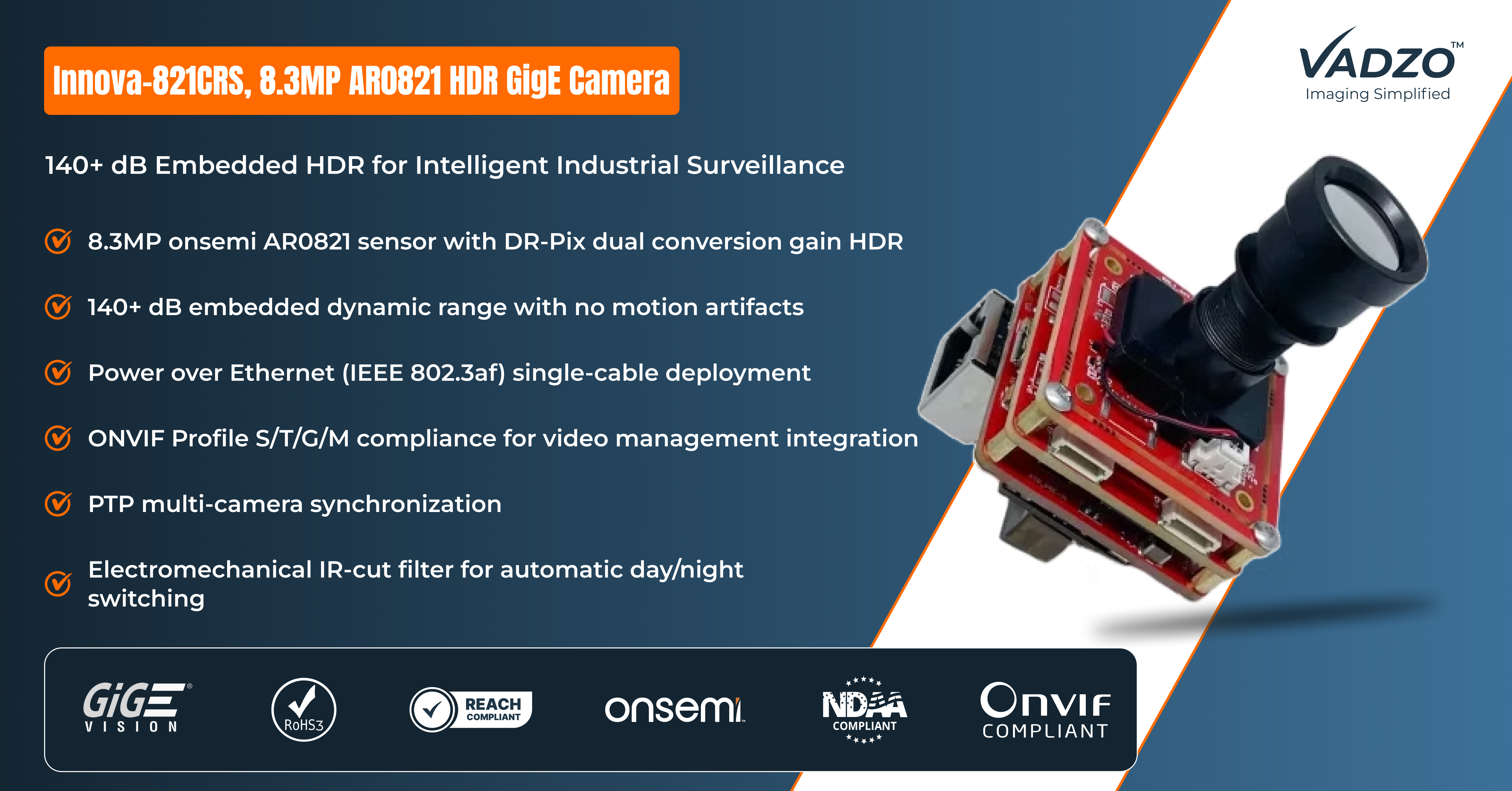
Vadzo Imaging’s Innova-821CRS is a 8.3MP HDR GigE camera built on the onsemi AR0821 CMOS sensor, engineered for industrial surveillance, smart city infrastructure, and machine vision deployments where extreme lighting differentials, multi-camera timing accuracy, and single cable installation determine whether a network camera node holds up in long-term outdoor and industrial service. In-pixel dual conversion gain delivers more than 140 dB of embedded HDR without motion artifacts, while Power over Ethernet, ONVIF compliance, and IEEE 1588 PTP synchronization bring the camera into standards-based video management and embedded vision networks alike.
FORT WORTH, TX / ACCESS Newswire / August 7, 2026 / Vadzo Imaging, a provider of embedded and machine vision camera products, today announced the launch of the Innova-821CRS, is an 8.3MP HDR GigE camera product built on the onsemi AR0821 CMOS image sensor. The Innova-821CRS extends Vadzo’s Gigabit Ethernet camera portfolio with a high-dynamic range platform engineered for industrial surveillance, critical infrastructure monitoring and machine vision deployments where extreme lighting conditions, multi-camera synchronization and standards-based network integration determine deployment success.
The Dynamic Range and Timing Problem in Industrial Surveillance
Industrial surveillance and critical infrastructure sites rarely offer a single controlled lighting condition. A loading dock camera product facing an open bay door captures bright daylight against dark interior racking in the same frame, a perimeter camera watching a gate must resolve a vehicle’s headlights and its license plate at the same time at night, and a factory floor camera near a welding station or reflective machinery deals with localized glare against a dim background. A standard CMOS sensor without in-pixel HDR processing forces a single exposure setting across the entire frame, so the bright region saturates, or the dark region drops into noise, and either outcome removes the detail an operator or a video analytics engine depends on. Multi-camera Gigabit Ethernet deployments add a second problem, since without a shared timing reference, frames from different camera nodes drift out of alignment relative to each other, complicating any workflow that needs to correlate footage across viewpoints. Long cable runs across a facility perimeter to add a third constraint, since running separate power alongside a data line to every camera location multiplies installation cost and points of failure.
Sensor Architecture Behind the Innova-821CRS
The Innova-821CRS is built on the onsemi AR0821, an 8.3MP CMOS image sensor using a 1/1.7-inch optical format with 2.1µm by 2.1µm backside illuminated pixels arranged for 3848 by 2168 resolution. As an Onsemi AR0821 GigE Camera product, the Innova-821CRS uses the sensor’s DR-Pix dual conversion gain technology at the pixel level, switching between a high conversion gain path for low-light signals and a low conversion gain path for bright highlights within the same exposure, rather than combining separate exposures captured at different moments. Because both gain paths read from the same photodiode during the same exposure window, the sensor avoids the ghosting that a multi-exposure HDR scheme introduces when a subject moves between frame intervals. The backside illuminated architecture also routes incident light more directly to the photodiode than a front side illuminated sensor of comparable pixel pitch, improving low light sensitivity for surveillance. Beyond the base dual conversion gain path, the AR0821 8MP GigE camera platform supports three exposure and four exposure eHDR modes along with a line interleaved HDR mode, letting integrators select the exposure method suited to a given lighting profile. Combined, these modes deliver more than 140 dB of dynamic range, while binning, scaling and mono summing extend usable sensitivity further for c operation. An electromechanical IR-cut filter on the S-Mount (M12) optical interface switches automatically between day and night configurations as ambient light drops toward the near infrared band.
Innova-821CRS Camera Platform Overview
Around the AR0821 sensor, the Innova-821CRS packages a complete 8MP color GigE camera platform in a compact three-board stack measuring 38mm by 38mm and weighing 25 grams without a lens. The camera connects through a standard RJ45 connector supporting both 100Base-T and 1000Base-T link speeds and draws power directly from the same cable through PoE compliant with IEEE 802.3af at 36 to 57 volts, removing the need for a separate power supply at each node. ONVIF Profile S, T, G and M compliance allows the Innova-821CRS to be discovered and added to standards-based video management platforms without proprietary integration work, while GPIO connections support external trigger input and multi-camera coordination signals. IEEE 1588 PTP support distributes a common clock reference across every camera node, keeping frame timing aligned across a distributed deployment. The camera operates across an extended -30°C to 85°C range, supporting outdoor and industrial floor installation without a separate thermal enclosure development cycle.
Key Capabilities of the Innova-821CRS 8.3MP HDR Gigabit Ethernet Camera
140+ dB Embedded HDR Without Motion Artifacts: A conventional multi-exposure HDR scheme captures two or more frames at different exposure times and merges them after the fact, which introduces ghosting whenever the subject or camera moves between exposures, a common condition at a vehicle gate or a factory floor. The Innova-821CRS avoids this by processing dual conversion gain in-pixel within a single exposure window, then extending range further with selectable three-exposure, four-exposure eHDR and line-interleaved HDR modes for scenes needing additional headroom. The result is an 8MP HDR PoE camera product that captures more than 140 dB of dynamic range without the temporal gap that produces motion artifacts, holding usable detail across a headlight-lit gate scene or a mixed daylight and shadow loading dock.
IEEE 1588 PTP Synchronization for Multi-Camera Coordination: Surveillance and inspection deployments that rely on more than one camera node to cover a site or track an object across overlapping fields of view need every node referencing the same clock. The Innova-821CRS implements IEEE 1588 Precision Time Protocol over its Gigabit Ethernet connection, distributing a shared time reference to every camera on the network without a dedicated hardware trigger cable running to each unit. This lets integrators correlate frames from multiple Innova-821CRS units covering a perimeter, an intersection, or a multi-station inspection line, and hand off a tracked object between camera fields of view with a known timing relationship rather than an approximate one.
Power over Ethernet and ONVIF Profile Compliance for Standards-based Deployment: USB-based interfaces cannot deliver power, data, and long cable runs at once, which becomes a limiting factor once a camera network extends across a facility’s perimeter or industrial site. The Innova-821CRS Gigabit Ethernet interface carries image data and power over a single cable as a AR0821 PoE Camera compliant with IEEE 802.3af, supporting standard 100Base-T and 1000Base-T link speeds through a single RJ45 connector. ONVIF Profile S, T, G and M compliance lets this HDR ONVIF Camera register directly with existing video management systems and network video recorders without proprietary drivers, so the Innova-821CRS drops into a standards-based surveillance network alongside GigE Vision embedded vision integration on the same platform.
Electromechanical Day/Night Switching with Binning for Low-Light Range: An S-Mount (M12) optical interface with an electromechanical IR-cut filter automatically switches the Innova-821CRS between color daytime imaging and IR-sensitive nighttime imaging as ambient light drops, removing the color shift a fixed or absent filter would otherwise produce after dark. When additional low-light sensitivity is needed beyond the base 8.3MP mode, binning, scaling, and mono summing combine adjacent pixel signals to raise per-pixel sensitivity at a reduced output resolution, letting integrators trade resolution for signal strength on demand rather than deploying a separate low-light optimized camera product.
Innova-821CRS Specifications
|
Sensor
|
AR0821 CMOS Sensor from Onsemi
|
|
Sensor Format
|
1/1.7-inch
|
|
Pixel Size
|
2.1µm x 2.1µm
|
|
Resolution
|
8.3MP, 3848(H) x 2168(V)
|
|
Shutter
|
Rolling Shutter
|
|
Chroma
|
Color
|
|
Dynamic Range
|
140+ dB embedded HDR (dual conversion gain, 3-exposure, 4-exposure eHDR, line-interleaved HDR)
|
|
Optics
|
S-Mount (M12 Standard) with Auto Switch IR-Cut Filter
|
|
Interface
|
100Base-T and 1000Base-T modes
|
|
Connector
|
Standard RJ45 Ethernet Interface
|
|
Power
|
Power over Ethernet, compliant with PoE 802.3af standard, 36 to 57V
|
|
Operating Temperature
|
-30°C to +85°C
|
|
Dimensions
|
Three Boards, 38mm (L) x 38mm (B)
|
|
Weight
|
25 Grams (without lens)
|
|
OS Supported
|
Windows, Linux, and Android
|
|
Compliance
|
ONVIF Compliant, RoHS 3, REACH
|
“Industrial surveillance customers have been asking us for a GigE camera that does not force a trade-off between dynamic range and motion accuracy, The AR0821’s in pixel dual conversion gain gives the Innova-821CRS more than 140 dB of HDR without the ghosting a multi exposure scheme introduces on a moving vehicle or a person walking through a gate and pairing that with IEEE 1588 PTP synchronization means integrators can deploy several units across a site and still correlate footage between them with confidence. That combination of dynamic range and timing accuracy is what a serious industrial surveillance deployment needs.”- Alwin Vincent, Product Manager, Vadzo Imaging
Target Applications
Industrial and Critical Infrastructure Security Surveillance: Perimeter fencing, gate access points and equipment yards at industrial sites and critical infrastructure facilities need continuous coverage that holds up under extreme lighting swings between daylight, vehicle headlights and unlit overnight conditions. As an industrial surveillance camera validated for ONVIF video management integration, the Innova-821CRS is an industrial security GigE camera and a smart industrial surveillance camera. It resolves a vehicle and its license plate at a gate at night without losing the surrounding scene to saturation or noise. Multi-camera PTP synchronization supports coordinated coverage across several entry points on a single standards-based network, giving industrial site security camera operators a documented timing relationship between camera nodes rather than an approximate one.
Smart City and Critical Infrastructure Monitoring: Municipal traffic intersections, public infrastructure sites, and outdoor monitoring installations require a network camera platform that survives temperature extremes while streaming reliably into a shared video management system. The Innova-821CRS -30°C to 85°C operating range and its PoE and 8MP ONVIF camera design let integrators mount this critical infrastructure surveillance camera outdoors without a separate thermal enclosure development cycle, while its embedded HDR resolves headlight glare and shadowed roadway detail in the same frame that a standard sensor would otherwise lose to saturation or noise.
Machine Vision, Robotics and Industrial Automation: Automated inspection camera lines, robotic guidance systems and factory floor monitoring stations depend on getting high-resolution frames to a shared vision controller without the cable length limits of a point-to-point interface. The Innova-821CRS 8.3MP output over Gigabit Ethernet lets multiple camera nodes feed a shared inspection or guidance controller over standard network infrastructure, while embedded HDR holds detail across reflective machinery and mixed ambient lighting common on a production floor. See how Vadzo supports automation and robotics camera deployments across similar industrial environments.
Frequently Asked Questions
Q: What is embedded HDR and why does it matter for industrial surveillance camera systems?
A: Embedded HDR refers to dynamic range processing implemented at the sensor or at the pixel level rather than through software blending of separately captured frames. A standard sensor without this capability forces a single exposure setting across an entire frame, so a bright region such as a vehicle headlight or a sunlit doorway saturates into a featureless area while a shaded region drops into noise, and either outcome removes detail an operator or a video analytics engine depends on. In pixel dual conversion gain reads a high-sensitivity path and a low-sensitivity path from the same photodiode within a single exposure window, avoiding the frame-to-frame gap that produces ghosting when a multi-exposure HDR scheme captures a moving subject. For industrial surveillance specifically, where scenes routinely combine headlight glare, deep shadow, and reflective machinery surfaces in the same field of view, embedded HDR is the difference between a camera product that resolves a license plate or a safety hazard at night and one that returns a blown-out or noise-obscured frame.
Q: What is the best 8MP GigE camera for industrial surveillance with embedded HDR?
A: The Innova-821CRS from Vadzo is 8MP HDR GigE camera product built on the onsemi AR0821 sensor, delivering more than 140 dB of embedded HDR through in-pixel dual conversion gain along with selectable three-exposure, four-exposure, and line-interleaved HDR modes. Its 2.1µm backside-illuminated pixel architecture extends low-light sensitivity for after-dark surveillance, while an electromechanical IR-cut filter automatically switches between color daytime imaging and IR-sensitive nighttime imaging. IEEE 1588 PTP synchronization keeps multiple camera nodes aligned to a shared clock, ONVIF Profile S, T, G, and M compliance allows direct registration with existing video management systems, and Power over Ethernet delivers power and data over a single cable. For OEM teams evaluating an 8MP HDR GigE camera or an 8MP Color GigE camera for surveillance monitoring, this platform combines resolution, dynamic range, and network standards support in one design.
Q: How does PTP synchronization improve multi-camera GigE Vision networks?
A: Precision Time Protocol, defined under IEEE 1588, distributes a shared clock reference across every camera node on a Gigabit Ethernet network with timing accuracy under a millisecond, replacing the dedicated hardware trigger cable that would otherwise run to each camera unit. In a multi-camera GigE Vision deployment covering a perimeter, an intersection, or a multi-station inspection line, PTP lets every node timestamp its frames against the same reference, so frames captured by different camera products at the same real-world instant can be correlated reliably rather than approximately. This matters most when a tracked object or a moving part needs to be handed off between overlapping camera fields of view, or when a defect detected downstream needs to be traced back to the exact frame captured by an upstream station. Networks without a dedicated PTP grandmaster clock can fall back to coarser NTP synchronization, though PTP remains the preferred choice wherever frame-level timing accuracy across multiple GigE camera nodes is a hard requirement.
Q: Which ONVIF compliant GigE camera supports PoE for single-cable industrial deployment?
A: The Innova-821CRS supports ONVIF Profile S, T, G and M compliance alongside Power over Ethernet compliant with IEEE 802.3af, letting a single RJ45 Ethernet cable carry image data and 36-to-57-volt power at once as an 8.3MP PoE camera. This removes the need for a separate power supply to run to every camera location, a capability that matters most once a deployment scales past a handful of nodes. Standard 100Base-T and 1000Base-T link speed support lets the Innova-821CRS integrate with existing network switch infrastructure rather than requiring a dedicated frame grabber or proprietary cabling. Combined with an extended -30°C to 85°C operating range, this AR0821 GigE camera platform is built for outdoor gate, perimeter, and industrial floor deployment where single cable installation and standards-based ONVIF discover both matters. Review the ONVIF and PoE GigE camera specifications to confirm compatibility with an existing video management deployment.
Q: What GigE camera works best for AI video analytics in critical infrastructure surveillance?
A: AI video analytics engines depend on consistent, detail-preserving input frames, and a camera product that loses detail to saturation or noise in high-contrast lighting will degrade detection and classification accuracy regardless of how capable the analytics model is. The Innova-821CRS 8.3MP AR0821 sensor functions as an AI video analytics camera and an edge video analytics GigE camera, delivering more than 140 dB of embedded HDR without the motion artifacts a multi-exposure scheme introduces, giving an analytics pipeline a consistent frame across the lighting swings common at critical infrastructure sites, from headlight glare at a gate to shadowed equipment yards at night. IEEE 1588 PTP synchronization additionally supports multi-camera analytics deployments that need to correlate detections across overlapping fields of view with a documented timing relationship. For infrastructure operators building an AI-powered surveillance camera network, this platform pairs with imaging performance with ONVIF compliance for direct integration into an existing video management stack.
Availability
The Innova-821CRS onsemi AR0821 8.3MP Color HDR GigE Camera with PoE and ONVIF is available now for evaluation and pre-production sampling, with production quantities available for OEM deployment. Engineering teams can access full technical datasheets and Vadzo NXT SDK documentation at vadzoimaging.com, or contact Vadzo’s sales team directly for volume pricing, customization requirements, and integration support.
About Vadzo Imaging
Vadzo Imaging develops embedded and machine vision camera products for OEMs and system integrators building production-ready vision systems across industrial automation, robotics, security infrastructure and smart city deployments. The company’s camera portfolio spans GigE, USB, MIPI CSI-2, Wi-Fi and SerDes interface camera products, supporting deployment architectures from board-level embedded payloads to distributed networked camera fleets. Vadzo provides end-to-end imaging support including sensor integration, ISP tuning, firmware development and SDK frameworks through the Vadzo NXT platform, helping engineering teams move from evaluation to volume deployment. Visit vadzoimaging.com to explore the full embedded vision camera portfolio.
Media Contact
Alwin Vincent
Vadzo Imaging
Email: alwin@vadzoimaging.com
LinkedIn: Vadzo Imaging
YouTube: Vadzo Imaging
X: Vadzo Imaging
SOURCE: Vadzo Imaging
View the original press release on ACCESS Newswire
Media gallery