
Frank Igwealor’s “Billionaire Trader’s Code” Launches Today, Offering Trading Discipline and Capital Preservation Rules
New Book “Billionaire Trader’s Code” Launches in eBook, Print, and Audiobook, Offering a Rule-Based Framework for

Press Release Disclaimer: This is a press release distributed through the XPR Media network. It has not been independently verified by our newsroom.
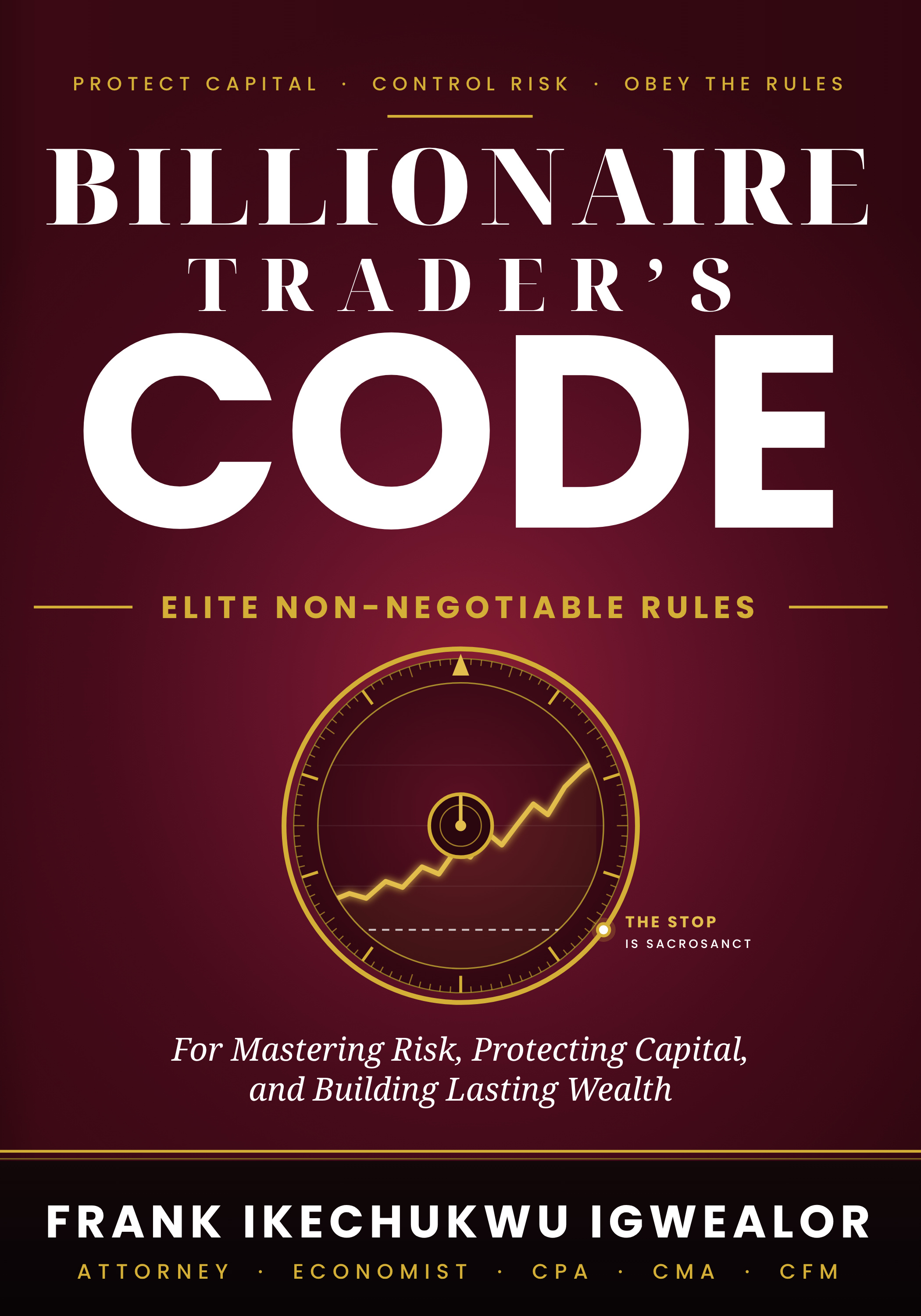

New Book “Billionaire Trader’s Code” Launches in eBook, Print, and Audiobook, Offering a Rule-Based Framework for Trading Discipline and Capital Preservation.
LOS ANGELES, CA, UNITED STATES, October 29, 2026 /EINPresswire.com/ — Attorney, Economist, CPA, CMA, CFM Frank Ikechukwu Igwealor announces the launch of Billionaire Trader’s Code: Elite Non-Negotiable Rules for Mastering Risk, Protecting Capital, and Building Lasting Wealth. The book is being introduced in three formats: an eBook and print edition through Amazon, and an audiobook through ElevenReader. Written for aspiring traders, experienced market participants, and individuals responsible for managing their own capital, the work challenges a familiar assumption about financial markets: that success depends primarily on accurately forecasting the next move in stocks, currencies, commodities, or other assets.
Instead, Igwealor argues that the more durable advantage comes from controlling what the trader can actually govern. The market’s direction is uncertain; the size of a position, the amount placed at risk, the conditions for exiting, the use of leverage, and the decision to remain in cash are choices. Across forty-one chapters, the book turns those choices into a coherent operating code intended to help readers replace improvisation with a documented process. Its central message is that protecting capital is not a secondary consideration. It is the prerequisite for remaining in the market long enough for any genuine trading edge to matter.
A DIFFERENT DEFINITION OF TRADING SUCCESS
Billionaire Trader’s Code is not organized around a supposedly infallible chart pattern, a list of hot stocks, or a forecast for the coming market cycle. It treats trading as a professional activity in which the quality of decisions matters more than the outcome of any one transaction. A trader can make a sound decision and lose money; another can take an irresponsible risk and temporarily profit. The distinction becomes meaningful over repeated decisions, changing market regimes, and the inevitable periods of adversity.
The book asks readers to think of trading capital as the operating inventory of a business rather than a scoreboard that must rise every day. Losses, commissions, spreads, financing charges, and taxes are real costs. A defensible strategy therefore requires more than occasional winners: it needs positive expectancy after costs, realistic sizing, reliable execution, and an ability to withstand setbacks without permanent impairment. By framing the trader as the manager of a small enterprise, the author shifts attention from excitement and prediction toward consistency, accountability, and survival.
THE NON-NEGOTIABLE COMMANDMENTS
At the center of the book are direct, memorable commandments intended to remain useful when markets are moving quickly and emotions are high. “Stop-losses are sacrosanct” establishes that an exit level set before entry should not be widened merely to avoid admitting a mistake. “Don’t fight the Fed” instructs readers to respect monetary policy, liquidity conditions, and the larger economic environment rather than insisting that an individual thesis must prevail. “Averaging down is for losers” warns against repeatedly committing more speculative trading capital to a position whose original thesis is failing.
Other commands include “Cut losers; let winners run,” “Never fight the tape,” “No edge, no trade,” and “Never revenge-trade.” The author also insists that no position should be large enough to end a trading career, that cash is a legitimate position when attractive opportunities are absent, and that the first obligation is to live to trade another day. These statements are presented as operational disciplines rather than promises that every trade will work. The book develops their rationale, limits, and applications throughout its chapters, with the complete collection of thirty commandments brought together in Chapter 41.
The commands also address a practical problem: rules are easiest to endorse when the account is calm and hardest to obey when a loss is unfolding. By encouraging traders to define risk limits and decision criteria before placing orders, the book aims to reduce the temptation to renegotiate those limits under pressure. It presents the written rulebook not as a decoration, but as an instrument of self-governance.
FROM POSITION SIZING TO PORTFOLIO SURVIVAL
The book’s risk-management sections move beyond slogans to examine the mechanics of capital protection. Topics include position sizing, stop placement, reward-to-risk asymmetry, portfolio concentration, correlation, leverage, liquidity, counterparty exposure, drawdown limits, and stress testing. Readers are encouraged to understand not only the possible reward from a trade, but also the financial and operational consequences if the position moves against them.
One recurring theme is that a series of small, controlled losses can be survivable, while a single unbounded loss can eliminate years of progress. The manuscript examines how position sizes should follow a risk budget rather than confidence, excitement, or a desire to recover previous losses. It also explains the value of daily and weekly loss limits, graduated drawdown responses, and predefined conditions for reducing exposure or suspending trading altogether.
BUILDING AN EDGE AND EXECUTING A PLAN
Beyond risk control, Billionaire Trader’s Code explores the work required to identify and test a genuine trading advantage. It reviews trading styles and time horizons, major strategy families, the development and evaluation of a repeatable edge, and the construction of a written trading plan. It also considers market structure, the roles of different market participants, technical and quantitative tools, execution costs, liquidity, and the risks surrounding economic announcements and other major events.
The author repeatedly distinguishes activity from opportunity. An open market does not create an obligation to place a trade, and a compelling narrative does not automatically justify a position. Readers are urged to define the setup, the trigger, the invalidation point, the expected reward, and the circumstances in which they will remain inactive. Journaling and performance measurement provide the feedback needed to determine whether a method works over a meaningful sample rather than merely appearing successful during a favorable stretch.
This emphasis on evidence is particularly important for traders tempted to increase size after a few wins. The book places proof before scale: first establish that a strategy has a defensible basis, then determine how much capital it can responsibly support. That sequence is designed to discourage the common mistake of using leverage or concentration to compensate for an unproven edge.
The manuscript also places special emphasis on knowing when not to trade. Market participants frequently treat inactivity as a failure to seize opportunity, yet the absence of a tested setup can make restraint the most defensible decision. By making cash an intentional allocation rather than an accidental leftover, the book argues for patience as an active part of risk management. This principle connects the first trade of a beginner to the larger preservation mandate of a mature portfolio: both depend on refusing exposures that cannot be justified.
THE PSYCHOLOGY OF THE TRADER
A substantial portion of the manuscript addresses the internal pressures that undermine even technically knowledgeable market participants. Fear, greed, overconfidence, impatience, loss aversion, and the impulse to recover money immediately can transform a planned trade into an uncontrolled gamble. The author examines emotional regulation, the discipline of inaction, the dangers of revenge trading, and the importance of separating self-worth from the result of an individual position.
In this framework, a trader’s journal is more than a record of entry and exit prices. It becomes a means of identifying recurring behavioral errors, reviewing adherence to rules, and distinguishing an unlucky outcome from a flawed decision. The book advocates routines, preparation, review, and honest measurement so that improvement can be pursued systematically. It also acknowledges that the ability to stop trading—temporarily or permanently—can be as important as the ability to enter a promising position.
LESSONS FROM HEDGE FUNDS AND FAMILY OFFICES
One of the book’s distinguishing features is its examination of how professional institutions organize the management of money. Chapters on hedge funds describe operating models, independent risk functions, capital allocation, multi-manager structures, research practices, and the disciplines associated with prominent investment firms. The purpose is not to suggest that an individual can reproduce a large institution’s resources. It is to show how a solo trader can adapt useful principles: documented mandates, explicit limits, performance review, and mechanisms that prevent emotion from overruling agreed rules.
The manuscript then turns to family offices and the different problem of preserving wealth. It discusses investment policy statements, governance, tax and asset-protection considerations, long-term capital allocation, and the tension between pursuing returns and protecting assets accumulated over time. This transition broadens the book’s scope from individual trades to the stewardship of capital across years and generations.
The author’s proposed ideal is an independent market participant who combines the rigor of an institutional risk process with the freedom of managing personal capital. That independence carries responsibility: without a separate risk officer or committee, individuals must create their own enforceable boundaries. The result is a book about building a personal institution, not merely selecting a trading strategy.
CASE STUDIES, TOOLS, AND PRACTICAL REFERENCE MATERIAL
The book uses historical market events and examples of prominent traders and institutions to contrast disciplined risk management with failures of governance, leverage, or judgment. The manuscript discusses episodes involving Long-Term Capital Management, Barings Bank, and other market participants to illustrate how apparently sophisticated operations can suffer catastrophic losses when safeguards fail. Such examples are presented for education, with attention to the transferable principle rather than a claim that history will repeat in exactly the same way.
Readers will also find recurring chapter features designed to reinforce application: an expensive lesson, a professional desk’s perspective, contrasting case files, and rules to live by. The back matter includes a one-page rulebook, position-sizing and risk formulas, templates, key ratios, sample institutional rules, case studies, a reading list, a glossary, and references. These resources are intended to help readers translate the broader philosophy into a personalized process appropriate to their experience and circumstances.
THREE FORMATS FOR DIFFERENT READING HABITS
The eBook and print editions of Billionaire Trader’s Code are offered through Amazon, allowing readers to choose between digital reading and a physical reference copy. The audiobook is offered through ElevenReader for listeners who prefer to engage with the material while commuting, exercising, or following a regular learning routine. Format availability, pricing, and supported listening options are determined by the respective platforms.
ABOUT THE AUTHOR
Frank Ikechukwu Igwealor is an attorney, economist, Certified Public Accountant (CPA), Certified Management Accountant (CMA), and Certified Financial Manager (CFM). His professional background informs the book’s attention to accounting, governance, legal and regulatory considerations, capital allocation, and the business responsibilities associated with managing financial risk. Billionaire Trader’s Code also draws together operating ideas from his related trading and investing manuscripts, including The Swing Trader’s Blueprint, The 10X Compounding Blueprint, and The 10X Stock Finder.
Rather than promise a shortcut to wealth, Igwealor presents the discipline of professional trading as a set of practices to be learned, tested, documented, and consistently enforced. His focus is on the decisions traders can control even when markets do not cooperate.
AVAILABILITY AND EDITORIAL NOTE
Billionaire Trader’s Code: Elite Non-Negotiable Rules for Mastering Risk, Protecting Capital, and Building Lasting Wealth is announced in eBook and print formats through Amazon and in audiobook format through ElevenReader. Readers can search for the title and author on the respective platforms. Publication details, prices, and regional availability should be confirmed on the relevant listing pages.
https://www.amazon.com/dp/B0HPMVMHQ4
The book is educational and informational, not individualized investment, legal, accounting, or tax advice. Trading and investing involve substantial risk, including possible loss of principal and, in some circumstances, losses greater than the original investment. No methodology described in the book guarantees profits or prevents losses. Readers should consider their financial circumstances and consult appropriately qualified professionals before acting on strategies discussed in the publication.
Frank Ikechukwu Igwealor
nihkreit@GMAIL.COM
Frank Ikechukwu Igwealor, CPA, CMA, CFM, ESQ.
Legal Disclaimer:
EIN Presswire provides this news content “as is” without warranty of any kind. We do not accept any responsibility or liability
for the accuracy, content, images, videos, licenses, completeness, legality, or reliability of the information contained in this
article. If you have any complaints or copyright issues related to this article, kindly contact the author above.

Media gallery

