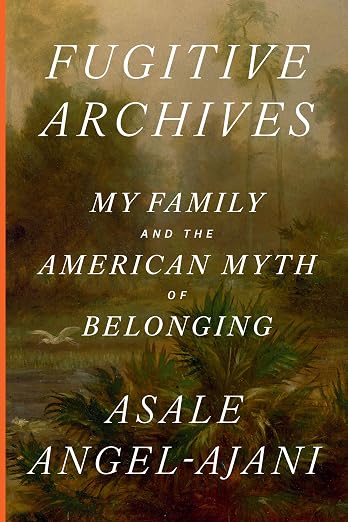
Fugitive Archives Traces How Race, Class, Love, and Hate Collide to Create a Fraught Family and National History
Anthropologist Asale Angel-Ajani traces a multiracial, working-class family from slavery through white supremacy and

Press Release Disclaimer: This is a press release distributed through the XPR Media network. It has not been independently verified by our newsroom.

Anthropologist Asale Angel-Ajani traces a multiracial, working-class family from slavery through white supremacy and DNA discovery to Stanford.
LOS ANGELES, CA, UNITED STATES, October 6, 2026 /EINPresswire.com/ — At sixteen, Asale Angel-Ajani didn’t have stable housing and was begging outside a 7-Eleven, when a white childhood friend recognized her and offered her a place to stay. He was a proud neo-Nazi.
That is just one of the contradictions at the center of Fugitive Archives: My Family and the American Myth of Belonging, a new work of narrative nonfiction published today by Algonquin Books. Angel-Ajani disproves one of America’s most familiar explanations for racism, that the problem is people being strangers. Americans of different backgrounds have always been connected through family, labor, land, law, and more.
Fugitive Archives arrives during the year of the United States’ 250th anniversary and publishes during Banned Books Week, October 4–10, 2026. It offers a family record for a public moment in which schools, libraries, museums, and governments are again debating whether histories of race, violence, and inequality belong inside the national story.
Angel-Ajani’s grandmother said she could identify their relatives beneath Ku Klux Klan robes by their shoes, and one man’s walk. Her great-grandmother belonged to the women’s Klan, whose influence moved through schools, churches, commerce, kitchens, and family pressure. Her white grandmother married Black men, yet often concealed her Black granddaughters’ identities as Hawaiian, Creole, and a white grandfather refused to meet his Black granddaughters while he comforted his Japanese American kin whose family had been incarcerated by the United States.
Angel-Ajani shares these family stories, and uses census schedules, court and military records, incarceration files, DNA matches, photographs, dreams, and scholarship, distinguishing what each can and cannot prove, to show, “Our story is the proof that the great American lie is not that we don’t know each other but that we have never, ever stopped knowing each other.”
The archive shows how colonial law offered poor Europeans the status of whiteness while protecting owners from cross-racial labor solidarity, how white women facilitated white supremacy through civic and domestic institutions, and how federal slave schedules preserved enslaved people as property while omitting their names. The book refuses to excuse white supremacy as economic anxiety or blame poor white people while ignoring the institutions that profit from division.
DNA gives Angel-Ajani both connection and dread. It cannot establish race, culture, tribal citizenship, or moral character. It helps confirm kinship, identify a half brother, and make possible a first family Zoom meeting. The book also shows white supremacists reinterpreting unwanted ancestry results rather than surrendering their ideology, another example of unwillingness to connect even in the face of evidence of connection.
“Empathy is not a guaranteed by-product of proximity,” she writes. Instead she calls for intimacy joined to truth, equity, accountability, and “fugitive coalitions,” alliances that refuse racial and economic bargains designed to divide ordinary people.
The book moves from a lost box of family photographs to the women’s Klan in 1920s Indiana, from Japanese American incarceration to an enslaved ancestor whose name survives in oral history, and from housing instability and community college to Stanford, where Angel-Ajani earned a doctorate and what she calls a “class lobotomy.”
“Fugitive Archives is a deeply moving and powerful account of America’s tortured landscape of race and class, all too often hidden behind the facade of a devotion to liberty and equality,” writes Annette Gordon-Reed, National Book Award-winning author of On Juneteenth and The Hemingses of Monticello. “A must-read as the country reaches 250 years of its existence.”
ABOUT THE AUTHOR
Angel-Ajani is also the author of the novel A Country You Can Leave and the nonfiction book Strange Trade. She is an associate professor at the City College of New York, where her main affiliation includes Anthropology, Gender Studies, and International Studies, with an additional Black Studies affiliation. She holds a PhD in anthropology from Stanford University and an MFA in creative writing from the University of Hong Kong. Her work has received support from the Ford, Mellon, and Rockefeller Foundations, and she was a Hutchins Family Fellow at Harvard University.
ABOUT THE BOOK
Fugitive Archives: My Family and the American Myth of Belonging is published today, October 6, 2026, by Algonquin Books. It explores race, class, and belonging through the history of one multiracial, working-class family. Blending memoir with archival research, Asale Angel-Ajani traces generations shaped by slavery and white supremacy and dismantles the myth that Americans are strangers to one another.
MEDIA CONTACT
To request a copy of “Fugitive Archives”, contact publicist Nanda Dyssou of Coriolis Company.
Nanda Dyssou
Coriolis
+1 424-226-6148
Visit us on social media:
LinkedIn
Bluesky
Instagram
Facebook
X
Legal Disclaimer:
EIN Presswire provides this news content “as is” without warranty of any kind. We do not accept any responsibility or liability
for the accuracy, content, images, videos, licenses, completeness, legality, or reliability of the information contained in this
article. If you have any complaints or copyright issues related to this article, kindly contact the author above.

Media gallery