
Cable Ampacity Is Not a Fixed Value: 90% of Projects Miscalculate Installation Derating
Rated ampacity is a lab benchmark, not an on-site guarantee: actual ampacity depends on coupled derating across

Press Release Disclaimer: This is a press release distributed through the XPR Media network. It has not been independently verified by our newsroom.
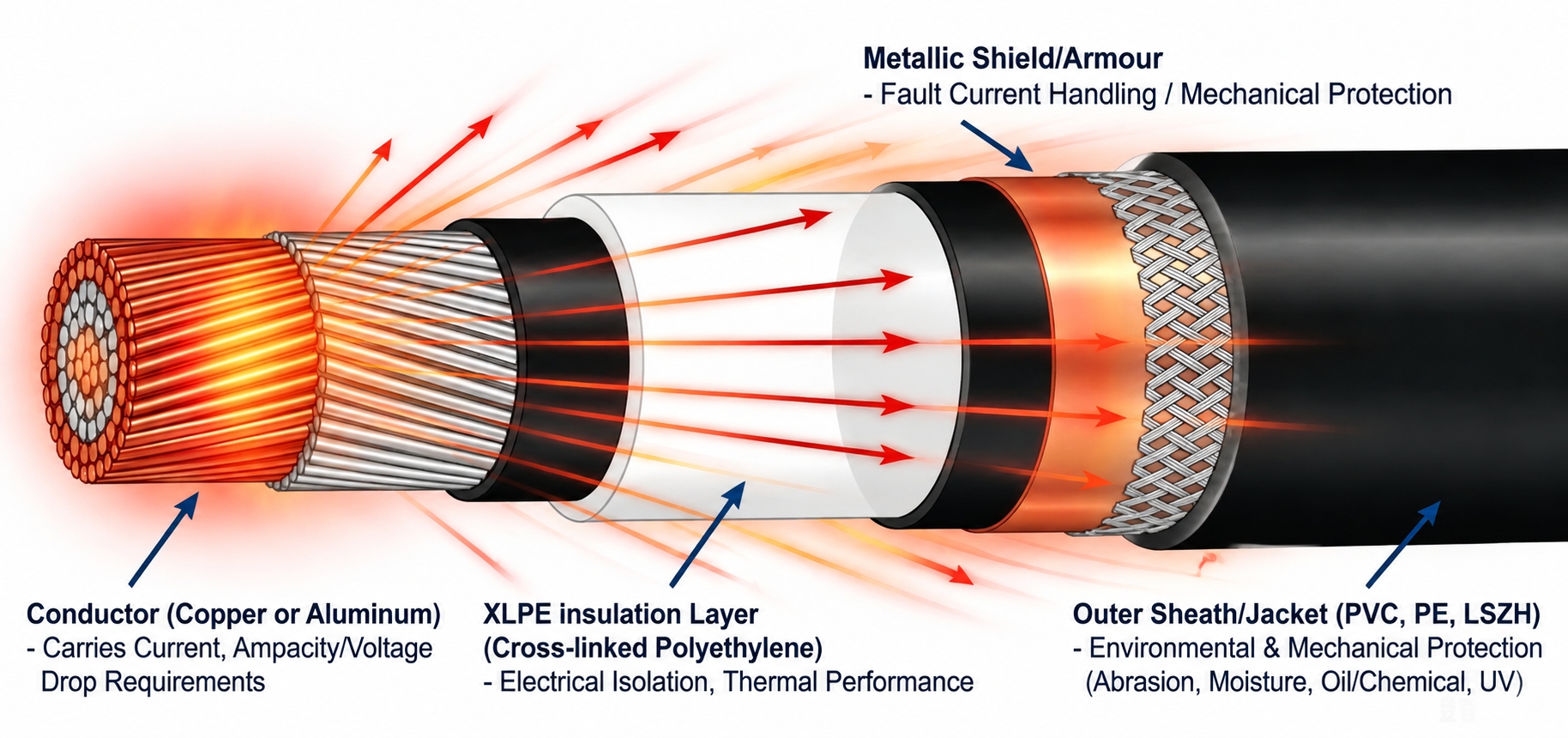

Rated ampacity is a lab benchmark, not an on-site guarantee: actual ampacity depends on coupled derating across ambient, installation and medium conditions.
AL, UNITED STATES, November 19, 2026 /EINPresswire.com/ — Drawing on industry-wide engineering statistics and project samples we have engaged with over the past three years, a widespread issue can be observed across global power transmission and distribution projects: roughly 92% of projects contain at least one omitted or miscalculated installation derating factor in the initial design, and nearly 30% see their actual available ampacity fall more than 25% below the designed value.
With 17 years of cable manufacturing experience and full-cycle visibility across hundreds of projects, we have repeatedly observed preventable on-site issues: overheated cables in outdoor cable trays in the Middle East, prematurely aged direct-buried cables in arid African regions, and tightly packed cables in factory trenches in Southeast Asia that exceed temperature limits at peak load. Almost all these hazards trace back to one widespread industry misconception—most stakeholders treat the nominal ampacity printed in cable datasheets as a fixed, absolute value.
From the dual perspective of a cable manufacturer and project researcher, we state clearly: ampacity is never an inherent property of a cable; it is a function of installation conditions. Miscalculating installation derating reduces upfront cable costs but creates decades of safety and service life liabilities.
1. The Truth About Nominal Ampacity: A Benchmark for Comparison, Not a Real-World Answer
To understand installation derating, one must first dispel the myth that “nominal ampacity equals actual usable current”.
Per the global standard IEC 60287-1-1:2023 for cable ampacity calculation, all compliant manufacturers publish nominal ampacity values under strictly uniform laboratory reference conditions: 25°C ambient temperature for single, unobstructed horizontal cables in air; 20°C soil temperature with 1.2 K·m/W thermal resistivity for single direct-buried cables at standard depth; and maximum conductor temperatures of 90°C for XLPE-insulated cables and 70°C for PVC-insulated cables.
These reference conditions exist to create a uniform performance benchmark for cross-product and cross-manufacturer comparison—not to match real project conditions. Physically, the upper limit of cable ampacity is determined not by the conductor’s current-carrying capacity alone, but by the combined heat resistance of the insulation and the efficiency of the heat dissipation path. Joule heat generated by the conductor passes through insulation and sheaths to the surrounding air or soil. When heat generation and dissipation reach equilibrium while the conductor stays within its temperature limit, the corresponding current is the allowable ampacity for that specific condition. Better heat dissipation means higher ampacity; poorer dissipation means lower ampacity.
As a manufacturer, every nominal ampacity value we publish is verified through type tests conducted by authoritative partner laboratories with 500kV high-voltage testing qualifications, in full compliance with IEC standards, with fully traceable data. However, of the nearly 10,000 inquiries we receive annually, over 80% of customers only ask “what is the ampacity of XX mm² cable” without specifying installation method, ambient temperature, or soil conditions. Many never notice the “reference conditions” disclaimer beneath every ampacity figure—and in reality, almost no engineering project perfectly matches ideal laboratory conditions.
2. Three Layers of Derating: Amplified Sizing Deviations
Many understand derating only as “a discount for high temperature”, but installation derating is a coupled effect of multiple factors, with deeper variables being the most overlooked and the most impactful.
2.1 Environmental Boundary Derating: Intuitive but Frequently Misapplied
Ambient temperature is the most understandable derating factor, yet also the most frequently misparameterized. Per IEC 60287-3-1 correction factors for XLPE cables: the factor is 1.04 at the 25°C reference, drops to 0.91 at 40°C, 0.87 at 45°C, and only 0.82 at 50°C.
Too many projects use annual average temperature instead of extreme maximum temperature for derating calculations—a critical error in tropical and subtropical regions. In areas of the Middle East and West Africa where summer surface temperatures exceed 50°C, ambient temperature alone reduces ampacity to 76% of the nominal value.
A representative case from an industrial park in Basra, Iraq, illustrates the real-world consequences of misapplied ambient derating. According to public data from the Iraqi Meteorological Organization, summer extreme surface temperatures in the region regularly exceed 51°C; for closed, sun-exposed cable trays, internal operating temperatures can rise a further 8–10°C, reaching nearly 60°C at peak afternoon hours.
The project’s initial design calculated cable ampacity using a 30°C ambient reference, a value based on annual average rather than extreme maximum conditions. Per IEC 60287-3-1 correction factors for 90°C XLPE-insulated cables, this 60°C actual ambient yields a derating factor of approximately 0.70, reducing available ampacity by 30% compared to the design assumption. Within six months of commissioning, the distribution system suffered frequent overheating trips during summer peak loads. Post-incident thermal analysis confirmed that sustained over-temperature operation had caused premature insulation aging, necessitating partial cable replacement.
Altitude is another overlooked factor: above 1000 m, lower air density weakens convective cooling, reducing ampacity by 3%–5% per 1000 m elevation.
2.2 Installation Configuration Derating: The Leading Cause of Sizing Errors
When multiple cables are installed in parallel groups, thermal radiation and convection create a heat-stacking effect: each cable dissipates its own heat while absorbing heat from adjacent cables, drastically worsening cooling conditions. This is the highest-error derating factor.
Per IEC 60364-5-52 group installation correction factors: six cables in tight contact inside a closed tray have a correction factor of only 0.57, effectively halving the ampacity. Even six cables in a single-layer perforated tray have a factor of 0.71; twelve bundled cables drop to 0.45.
An analysis of 500 cable thermal failure forensic reports by international power engineering body ECalPro found that 28% of cable insulation failures result from thermal damage due to group installation. Alarmingly, 82% of these cases had correct initial sizing at commissioning; failures stemmed from post-construction changes: 55.7% added extra cables to existing trays, 23.5% added circuits to shared conduits, and 10.4% added tray covers that restricted ventilation—none of which triggered a recalculation of ampacity.
This matches our on-site experience: designs specify four cables per tray, but on-site teams pack six or eight into the same tray or conduit to save space and time, without notifying designers or performing thermal verification. These changes are highly invisible, often only discovered after one or two years of overheating trips and insulation degradation.
Additionally, harmonic derating is missed in 90% of industrial projects. Non-linear loads such as variable-frequency drives, UPS systems, and LED lighting generate significant harmonic currents that cause extra conductor heating, requiring an additional 20%–40% derating per IEC standards and field practice. In nearly half of the Southeast Asian manufacturing park projects we support, initial designs ignored harmonics, resulting in cable operating temperatures 10–15°C higher than expected and severely reduced insulation life.
2.3 Hidden Medium Derating: 90% of Direct-Buried Projects Ignore Soil Thermal Resistivity
If group installation derating is visible to observation, soil thermal resistivity is the most invisible “service life killer” for direct-buried cables, and the parameter missed in 90% of direct-buried projects.
A well-documented 10kV municipal distribution project in arid West Africa offers a concrete demonstration of this coupled derating effect. The initial design specified 3×120 mm² XLPE armoured cables with a nominal ampacity of 310A, calculated using the default reference soil thermal resistivity of 1.2 K·m/W without on-site soil thermal testing.
Post-survey confirmed the site consisted of dry sandy soil with a measured thermal resistivity of 2.2 K·m/W, compounded by eight cables installed in a shared trench with standard close spacing. A coupled thermal calculation per IEC 60287-1-1 showed the actual available ampacity was only approximately 195A — nearly 37% below the design value — which would have posed a high risk of insulation breakdown under peak summer load.
Through targeted installation optimization — adjusting cable spacing to reduce mutual heating and replacing trench backfill with compacted fine soil to lower local thermal resistivity — the effective ampacity was raised to 260A, achieved without increasing cable cross-section or overall material procurement cost. This case directly exemplifies the 16% direct-buried failure risk attributed to uncorrected soil resistivity in ECalPro’s industry statistics, and highlights that thermal optimization of installation conditions often delivers higher cost performance than blindly upsizing cable specifications.
The Ultimate Cost of Derating Errors: Every 10°C Overload Halves Insulation Life
Many assume “a small ampacity miscalculation won’t matter”, but from an insulation aging perspective, temperature affects lifespan exponentially.
Based on the Arrhenius law of chemical kinetics, the industry-standard “10-degree rule” recognized by IEEE and IEC holds that every 10°C increase above the rated operating temperature halves the service life of cable insulation. An XLPE cable with a 30-year design life, if run continuously 10°C above rating, lasts only 15 years; 20°C over, 7.5 years; 30°C over, less than 4 years. Domestic cable aging test data confirms this: 90°C-rated cross-linked polyolefin cable operated at 105°C has a service life of only 6.3 years, less than one-quarter of its rated life.
As a manufacturer, our greatest concern is seeing qualified products fail prematurely due to incorrect sizing. Many owners only look at unit purchase cost, not total lifecycle cost: the replacement cost, downtime loss, and maintenance cost of an overheated cable are typically 3–5 times the initial purchase price. Cables are the blood vessels of power systems; their safety should not be compromised by simplified tables and habitual assumptions.
3. Why 90% of Projects Get It Wrong: Three Industry Blind Spots
Derating calculation logic is well established in international standards. The 90% error rate stems not from technical difficulty, but from industry-wide path dependence and cognitive blind spots across the entire value chain.
First, design-side simplification inertia: rigorous thermal balance calculation has been reduced to table lookup. ECalPro analyzed 10,247 cable sizing calculation documents and found derating errors in 34% of them: 41% omitted group installation factors, 29% used incorrect ambient temperatures, and 16% ignored soil thermal resistivity. Many designers reduce cable selection to a three-step process: calculate load current, compare to datasheet values, pick a cross-section. They default to standard reference conditions, without verifying cable count, spacing, or soil resistivity, and without performing multi-factor coupled thermal verification. This approach works acceptably for simple single-cable installations, but deviations grow rapidly in dense installations and harsh environments.
Second, uncontrolled construction-side changes: hidden condition changes go without electrical verification. Construction changes are normal in engineering, but electrical parameter verification is often skipped. Adding a few cables to a tray or conduit seems trivial to contractors, but it fundamentally alters the cable’s thermal environment. Worse, most such changes never appear on as-built drawings, becoming hidden time bombs in operation. In the failure cases we have encountered, over half of cable overheating issues trace back to unverified construction changes.
Third, cost-side downward pressure: saving money today by risking long-term safety. In a price-competitive market, some contractors and owners deliberately size cables to the upper limit of nominal ampacity, or even ask manufacturers to “inflate the ampacity number”, with zero safety margin. This is a line we will never cross as a compliant manufacturer—ampacity is a rigorous parameter based on standards and testing, not a marketing figure. At the opposite extreme, some assume “oversizing is always safe”. In reality, blind oversizing not only wastes procurement cost, but also mismatches protection devices: larger crosssections lower cable impedance, raising prospective fault current. If protective devices are not rated for this higher fault level, they may fail to clear faults safely, raising arc flash hazards. The professional approach is accurate conditionbased sizing, not oversizing to compensate for lazy calculation.
4. From Selling Cables to Delivering Solutions: The Core Value of a Professional Manufacturer
With 17 years of industry experience and exports to over 60 countries, XWA Power & Cable believes a strong cable enterprise should be more than a product supplier—it should be an electrical solution partner for its customers. Delivering compliant cables is the baseline; helping customers select and use cables correctly is the core value we bring.
On the product side, our full cable range is manufactured in strict accordance with IEC, BS, and ANSI/NEMA international standards, covering low voltage (0.6/1kV), medium voltage (6–35kV), and high voltage up to 500kV. All nominal ampacity values are based on complete type test data with full traceability. Our factory is equipped with comprehensive in-house production testing equipment, and every metre of cable undergoes 100% inspection before delivery. We also maintain deep partnerships with authoritative high-voltage laboratories holding 500kV testing qualifications, enabling full-voltage type testing and performance calibration to ensure electrical and thermal performance matches nominal parameters—the foundation of accurate ampacity calculation.
On the technical service side, XWA’s dedicated technical support team has built a full-condition ampacity calculation system based on IEC 60287, with a project database covering global climate, soil, and installation scenarios. By providing installation method, ambient temperature, soil parameters, cable count, and load type, customers receive accurate multi-factor coupled derating verification, plus complete recommendations for cable cross-section selection and installation optimization. Among the cable sizing consultation cases we have handled in recent years, many show inadequate derating consideration in their initial design. By providing targeted optimization recommendations before commissioning, we help customers mitigate potential safety risks and reduce avoidable economic losses.
Our product portfolio covers every application scenario: LV/MV/HV power cables, ACSR overhead conductors, submarine cables, solar PV cables, mining cables, and fire-resistant cables, all available in copper or aluminium conductors, armoured or unarmoured, with XLPE or PVC insulation. For high-temperature, high-humidity, high-corrosion, and arid environments, we offer specialized cable solutions tailored to local thermal and durability requirements.
To date, XWA has established long-term partnerships with hundreds of global clients including State Grid Corporation of China, Power China, Worley, and ENSA Panama, serving power infrastructure, industrial facilities, and renewable energy projects worldwide. Our team is familiar with regional standards and climatic conditions, and typically responds to technical inquiries and quotation requests within 24 hours.
Closing
After years in the cable industry, we hold one truth above all: the value of a cable is not measured in metres, but in the years of safe, reliable power system operation it enables. Installation derating is not a cold discount factor; it embodies the physics of thermal equilibrium, the baseline of engineering safety, and the economics of total lifecycle cost.
As a Chinese cable manufacturer, we aim to be more than an order-fulfilling supplier—we strive to be a trusted power solution partner for every customer. We bring 17 years of manufacturing expertise and global project experience to deliver safety margin and economic value to every project. After all, our products only fulfill their mission when our customers’ projects operate safely and reliably.
joaquin Fan
XWA Power & Cable
+86 153 2498 1792
fan@xwacable.com
Legal Disclaimer:
EIN Presswire provides this news content “as is” without warranty of any kind. We do not accept any responsibility or liability
for the accuracy, content, images, videos, licenses, completeness, legality, or reliability of the information contained in this
article. If you have any complaints or copyright issues related to this article, kindly contact the author above.

Media gallery


